Not many people can honestly say they made their childhood dream come true. Sales Wick can. In the summer of 2018 he was a senior first officer on the Boeing 777-300ER at SWISS, the largest twin-engine airliner of its day, and every month he flew thousands of passengers to other continents and home again.
We had met in Zurich a while before. Like me, he took his camera to work, and he ran an aviation blog of his own. Then he asked whether I would like to come along for a weekend at work: out on LX 40 to Los Angeles, about 50 hours in California, and back home on LX 41. With official permission from SWISS, I spent both flights on the jump seat behind the pilots. That is how my own childhood dream came true.
Three days full of wide landscapes, the skyline of downtown Los Angeles, Long Beach at night and even a flight into the desert, plus a close look at how pilots run a long flight across the Atlantic. Fasten your seat belts.
Hour zero: Birchermüesli
A basic rule of life holds for pilots too: start the day right. So before the long flight there is a good night’s sleep, a big Swiss breakfast with Birchermüesli and a large cup of the fuel that reliably keeps most pilots going: coffee.
Before we leave, Sales puts on his uniform and we pack the last things. Cameras? Packed. Batteries? Charged. SD cards? Empty. Off we go.
1:15 before take-off: time for the briefing

Sales lives close to the airport, so his commute is short. One hour and fifteen minutes before take-off the briefing begins at the SWISS Operation Center, where Sales meets the rest of the cockpit crew. At an airline this size the same crew rarely flies together twice, and that is deliberate: it keeps pilots from relying on each other blindly out of routine.
The captain today is Patrick Widmer. Thierry Schwank completes the crew, a senior first officer like Sales; the two know each other from their type rating on the 777. There is no time to relax yet, though. A flight needs planning.

First, flight dispatch hands us the planned route for LX 40. Because of the winds high up, it takes us far north: from Switzerland across Germany and Denmark, past the south of Norway and right across the heart of Greenland, all the way up to 73 degrees north. After Greenland we fly over water until we reach Canada and the American mainland. From there we head south-west, enter the United States over Idaho and the Rocky Mountains, cross Yosemite National Park in California and follow the Pacific coast via Santa Monica into the Los Angeles area.
With the documents ready, the actual briefing starts. The cockpit crew goes through the whole flight: the route, the weather along the way, the winds and the NOTAMs, the Notices to Airmen. They are short messages every crew has to know before departure. Is a runway or a taxiway at the destination closed for a while? Is a navigation aid out of service?
All of this helps decide how much fuel we take. An important part of the briefing is the situation at the alternate airports for every stage of the route, again with the help of the NOTAMs. A diversion can have many reasons: a medical emergency, a technical fault or simply weather that is too bad at the destination. Preparation is the most important thing in aviation.
Then the cockpit crew briefs the cabin crew on the day’s flight. Since I am a normal passenger, I go through security and passport control. While both first officers prepare the cockpit and start up the aircraft, Patrick heads out to the ramp, another place where a lot happens before the passengers board.
While our Boeing 777-300ER is loaded with cargo, catering and equipment and the passengers’ bags go on board, a specially trained and qualified mechanic does the pre-flight check. He walks around the aircraft and checks the critical points for airworthiness. After that, the captain makes his own round, inspects the Triple Seven and accepts it. Everything is perfect today for LX 40.


Patrick inspects one of the two GE90-115B engines that power the 777-300ER. No engine in airline service delivers more thrust than this masterpiece by General Electric. One of its fan blades is in the collection of the Museum of Modern Art in New York, for its elegant curved shape. On my flight to Tokyo on the 777 Freighter I even stood inside a GE90.
LX 40: start-up and into the flight deck
73.9 metres long, 64.8 metres from wingtip to wingtip, a maximum take-off weight of more than 351 tonnes and a range of 13,649 kilometres, with space for 340 passengers: that was the Boeing 777-300ER back then, the SWISS flagship. Now it is my turn to board.
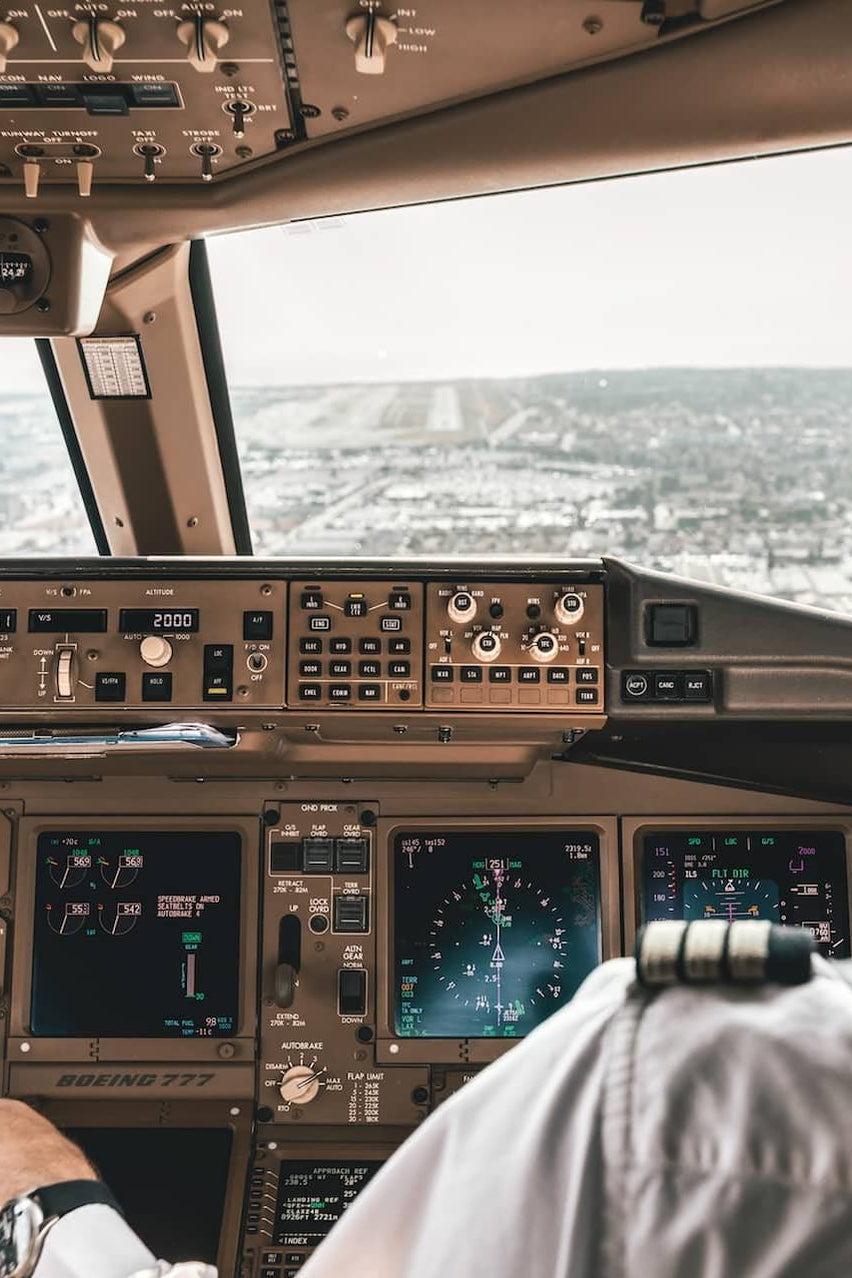
After a short introduction to the cabin crew and their maître de cabine, as SWISS calls the purser, I sit down on the jump seat, the observer’s seat behind the two pilots, surrounded by the striking Boeing brown of the cockpit. It feels incredible. There is more about the jump seat in my story from the A350 cockpit.

Patrick, the commander of the flight, goes through the take-off with the crew once more. Thierry will fly it as pilot flying, and Sales will take over for the landing in Los Angeles 11 hours and 25 minutes later. As pilot monitoring, Patrick supports the two and handles the radio. On the way home the roles will be reversed: the captain at the controls for take-off and landing, the first officers supporting him as pilots monitoring. Taking turns like this is normal.
Now Zurich Delivery gives us the route clearance. As soon as the flight management computer has all the information and the cockpit is ready, so are we: ready for push-back. Now it gets serious.
While the tug pushes us back, Patrick starts the two GE90s, Thierry sets the flaps to 15 and Patrick checks that all control surfaces move freely. A few minutes later we are cleared to taxi to runway 16, which points south-east.

We queue up behind a few other aircraft waiting to take off. Then the tower: “SWISS 40 heavy, line up and wait runway 16.” Patrick carefully steers the Triple Seven, about 345 tonnes of it, onto the runway.

“SWISS 40 heavy, cleared for take-off runway 16”
Then comes a moment of complete quiet, and everyone waits for the controller’s words. “SWISS 40 heavy, cleared for take-off runway 16.” Patrick pushes the thrust levers forward, and the two GE90s wind up to a deep, sonorous roar. They accelerate our 777-300ER towards the safe climb speed calculated before the flight, 178 knots. “80 knots.” “V1.” “Rotate.” “V2.” About 45 seconds later, 345 tonnes lift seemingly without effort into the Zurich afternoon sky. Right after take-off Thierry turns left towards the east, which keeps the noise away from the people living around the airport.


Crossing the Atlantic
Pilots fly the aircraft by hand for only seven to eight minutes per flight. Once the autopilot is in, the crew still has a lot to do. Lean back and look out of the window for eleven hours? Far from it. Even the autopilot has to be monitored all the time. Rather than flying, the pilots now manage the aircraft.
A fuel check is due every hour, for example: at certain waypoints the crew compares the fuel actually used with the planned figures. Instruments and computers make mistakes too, just like people, so the crew keeps analysing every value and questions it critically.
Do pilots sleep on long flights?
Yes, in turns. On very long flights an airline can add an extra pilot, so that every pilot gets a rest period during the cruise, above all the two who will be at the controls for the landing.
On LX 40 the three are Patrick, Sales and Thierry. At SWISS it was common to have three pilots on very long flights, so that each of them could get enough rest to be fully focused for the critical phases, take-off and landing. We climb to our initial cruising altitude of 32,000 feet, and Sales takes the first break. About halfway it is Patrick’s turn. As the senior first officer, Sales covers for him for the next three and a half hours as commander of the aircraft and takes over the left seat. Experienced first officers need special additional training for that role.
Behind this is a principle of European flight-time rules: a crew may stay on duty longer if an extra pilot is on board and every pilot gets a rest period during the flight.
The North Atlantic and Greenland

Obviously we are not the only ones who want to cross the North Atlantic today. No other oceanic airspace in the world is as busy. At the same time, radar coverage over the ocean is weaker, so the traffic has to be separated very precisely. That is why we receive our North Atlantic clearance long before we enter this airspace.
Today we fly a random route, a route of our own. Other flights are assigned one of the North Atlantic Tracks. These tracks are published anew every day and adapted to the weather, and each flight on them keeps to the published route at an assigned altitude. They begin and end at waypoints in Western Europe and North America.
About 90 minutes before we reach the North Atlantic airspace, we get the oceanic clearance from the responsible oceanic control centre, as was still usual back then. Each time we pass a new waypoint on our route, the aircraft reports its position automatically by datalink: the time, our altitude and the estimates for the next waypoints.
For the first four hours of LX 40 we see nothing but thick cloud. Then, over Greenland, the grey and white shroud finally lifts, and we look down on the endless ice of the glacier.

LX 40: approaching Southern California
Some time later I leave the cockpit to catch some sleep, and I wake up just in time for the moment we enter American airspace. Unfortunately, Yosemite National Park is hidden under thick cloud. By now we have flown most of the way.

In about 40 minutes Sales will land the almost 74-metre-long Triple Seven in Los Angeles. Before the approach to the Californian metropolis, the senior first officer speaks to the passengers once more about the flight and the weather at the destination.

SoCal Approach, the controllers for Southern California, puts us on the IRNMN TWO arrival, which you read as “Iron Man”. It first leads us straight ahead until we reach the Pacific coast. At 9,000 feet, about 2.7 kilometres up, we fly over Santa Monica and turn onto a heading of 071 degrees, which takes us past LAX, parallel to its runways.
That gives us a spectacular view of the Hollywood sign and downtown Los Angeles, before we turn onto the final approach for runway 24R. Beautiful as the view is, the landing is a critical phase of every flight, with a high workload for the whole crew, especially in an airspace as busy as the one around Los Angeles. On the jump seat I have time to enjoy the panorama in the last minutes of LX 40.

The crew intercepts the instrument landing system, which guides us down the ideal glide path to the runway. Sales switches off the autopilot and flies the aircraft by hand. On the final approach a distinctive computer voice counts down our height above the ground in feet. Shortly after “two thousand five hundred”, Sales asks Patrick for “gear down” and then for the flaps to be fully extended, so that the wings keep enough lift as we slow down.

“Three hundred … two hundred … minimums.” Minimums means the decision height: if the runway were not in sight now, we would have to go around. But the Californian sun gives us perfect visibility. “Continue,” Sales replies, his eyes moving between the instruments and the runway, aiming for a touchdown about 300 metres past the threshold. It becomes a gentle landing. After 11 hours and 26 minutes we are on American soil, at about twenty past four in the afternoon local time, and Los Angeles welcomes us with fantastic weather. Off to the crew hotel, a good meal in Long Beach and an exciting layover in the Golden State. LX 40 out.

After LX 40 it is time for a proper layover, and then for the flight back.
“My name is Dick, and I flew around the world”: Mojave
After a relaxing evening in Long Beach and a hearty breakfast, we rent a small Cessna 172 at the local airport, Long Beach. Patrick and Sales take turns at the controls. Today’s destination is Mojave Air and Space Port, which, among other things, stores retired airliners. The dry desert air and the sun that almost always shines make perfect conditions for storing them for future owners, or for scrapping the poor birds.

The Air and Space Port has more than interesting aircraft: a decent snack bar with rather delicious burgers, and countless mementos of the brothers Burt and Dick Rutan. In the 1980s Burt designed the legendary Rutan Voyager, which Dick Rutan and Jeana Yeager flew around the world in December 1986, non-stop and without refuelling, in nine days, three minutes and 44 seconds. To our great delight, an older gentleman spoke to us while we were eating. It was Dick himself. “Hi, my name is Dick, and I flew around the world,” he said, and proudly told his story. Dick Rutan died in 2024. Since 2022 the airport has carried the Rutan name: Mojave Air and Space Port at Rutan Field.
A little later we refuel our little Cessna and set off home. The next stop is a small airport south of Los Angeles, Hawthorne, where we board a helicopter for a sightseeing flight with a panoramic view of the city and the international airport. Before we land at Hawthorne, though, we fly a long loop around downtown Los Angeles. The skyscrapers there stick out like needles from a city that is otherwise rather flat: for half a century Los Angeles allowed nothing taller than 150 feet.


After an exciting day of flying, the sun sets into the ocean in the west, and we watch it go down from above. Night falls, and the sunlight gives way to a sea of lights that never seems to end. We take off once more, for a short evening flight in the Cessna from Hawthorne back to Long Beach.

We fly over the Port of Long Beach. After the Port of Los Angeles it is the largest container port in the United States, a gateway for trade between North America and Asia. Before we land on runway 30 at Long Beach, we take a quick look at Rainbow Harbor and our crew hotel. Then, after a big dinner, it is time to rest for the next day: LX 41 is coming up.


Welcome to LX 41
While I wait for the return flight at the gate in the Tom Bradley International Terminal, I can already see the crew of LX 41 in the cockpit. Time for a photo from outside.

This time it is the other way round: Patrick is pilot flying and takes us back to Zurich, while Sales and Thierry support him as pilots monitoring.

Right after take-off, runway 24L sends us straight out over the open Pacific. Then we will turn left and fly over the city towards the north-east. The briefing is over, and off we go. We roll past many widebody aircraft on our way to runway 24L.

We leave American soil at about 320 km/h and head out over the ocean. The blue hour begins, the sun slowly sets, and darkness stays with us for hours. On the way, we fly over Las Vegas, and from our cruising altitude we get an incredible view of Sin City.

We fly on through pitch-black darkness for a few more hours, and I go to sleep. When I come back to the cockpit, the sun greets us in all its glory, and once again the blue hour is at its best.


A few more hours go by until we reach the European mainland over France. Once more it is clear that pilots have to assess the situation actively at all times: a few thunderstorm clouds have built up around us. The weather radar shows them on the navigation display in green, yellow and red, depending on how heavy the rain inside them is. The crew has to find a way around or between them.


The weather calms down, and we enjoy a wonderful approach over Basel before we land on runway 14 in Zurich.


The weather at home is warm, almost like California. Lucky us. Captain Patrick gently puts his Boeing 777-300ER down on Swiss soil and taxis to the gate. Another transatlantic flight is over, and faster than the way out, thanks to the jet stream, a narrow band of strong wind at cruising height that blows mostly from the west. The tailwind gives us a proper boost: at one point the display showed 93 knots of wind, most of it from behind. Time for one last aircraft selfie at the gate. LX 41 heavy out.

Then the weekend is over, and I won’t forget it, or this aircraft. I got to know the pilot’s job in amazing detail. It cannot be compared with anything else, and to me it is still a dream job. Thank you, Sales, Thierry and Patrick, and of course SWISS, for making this possible.
No photograph from this trip is in the shop. A 777 cockpit is, though: Golden Approach to Tokyo, from the approach into Narita. More photographs from the flight deck hang next to it, and there are more stories from the jump seat on the Stories page.
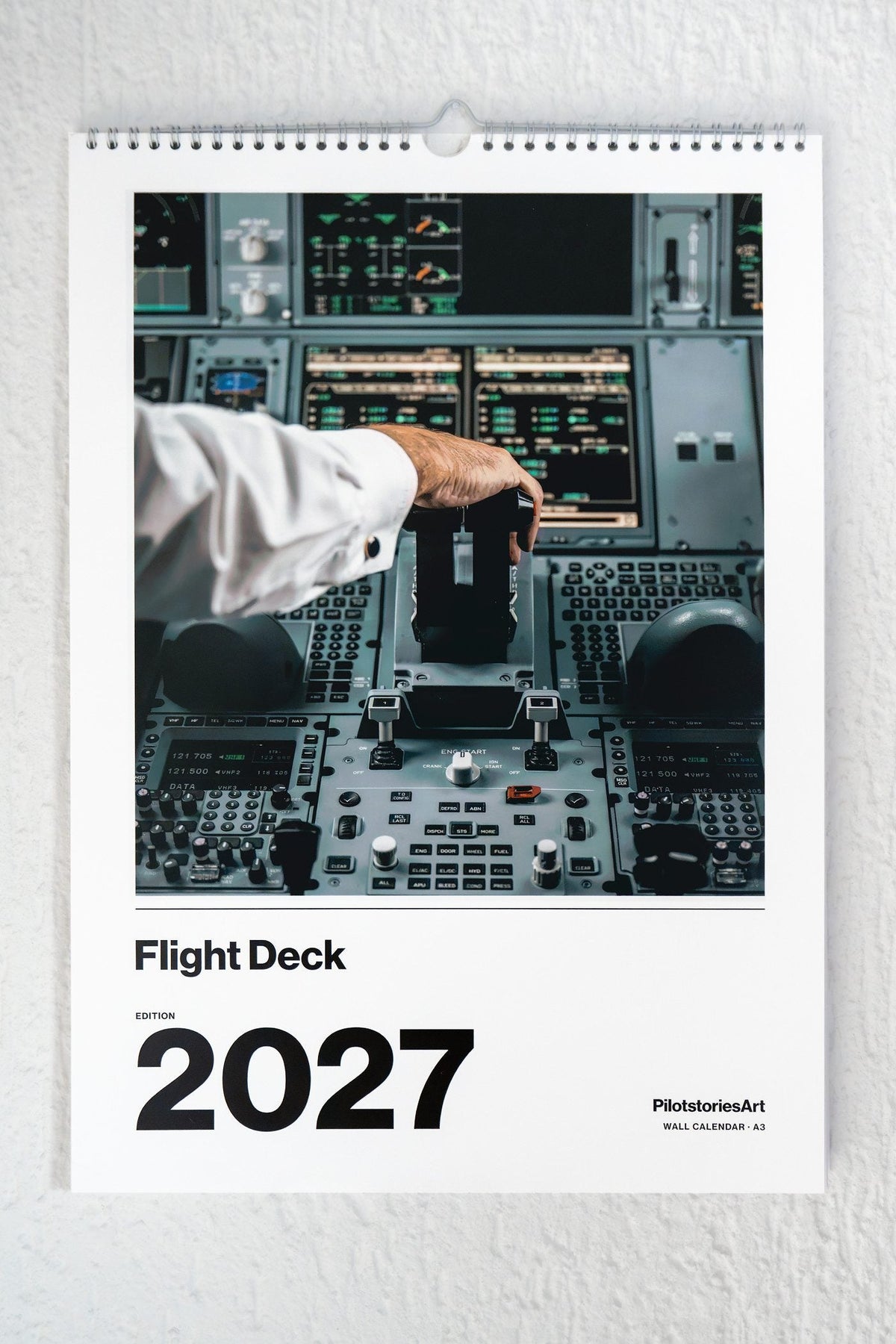
The 777 turns up twice in the Flight Deck 2027 wall calendar, both times as a freighter. In July it is descending towards Tokyo, and in November it is about to taxi out at Seoul Incheon after dark.
Happy landings,
Aaron