I had been up since early morning, and the night owls among you know the little tricks a tired brain likes to play. This time, though, we had read it right. Zurich Airport. The display in the apron bus said flight LX 7525, destination “Zuerich”. Odd as it sounds, that was the plan. On the menu for the day was a sightseeing flight with Swiss: once across the Alps of Switzerland and Italy, plenty of time for the view, and back to the Helvetic metropolis.
In 2018 I tried my luck in a photo competition run by Zurich Airport, with a seat on this flight up for grabs. It worked. On 8 December it was time. I packed my things, camera included, and set off for the airport. The aircraft of the day was HB-JBE, an Airbus A220-100. When it was delivered on 30 December 2016, the fifth of its kind in the fleet, the type was still called the Bombardier CS100. By the day of the flight it had been an Airbus for five months, in name at least.

Zurich sent us off in proper December weather. The airport’s weather reports that afternoon read light rain showers and broken cloud a few thousand feet up, with gusts of up to 27 knots. No reason for gloom, though, because south of the main Alpine ridge Lugano, Bergamo and Bolzano reported CAVOK all afternoon. It stands for cloud and visibility OK, which was an understatement. Proper photo weather.

We took off from runway 32 with TOGA, full take-off thrust, and soon pushed up through the cloud towards the sun. On the northern side the valleys were still veiled in grey, and the further south we flew, the clearer it got. Happily, I had landed one of the coveted window seats. According to Airbus, the A220 has the largest windows of any single-aisle jet. For a photographer, there are worse places to sit.

My camera and I could hardly get enough of the glorious scenery, and the shutter came close to overheating. One of those countless frames became my print Alpine Pass. The wing leads the eye out to the winglet, with the ridges of the Italian Alps stacked up behind it. Snow and shadow give them a strong contrast.


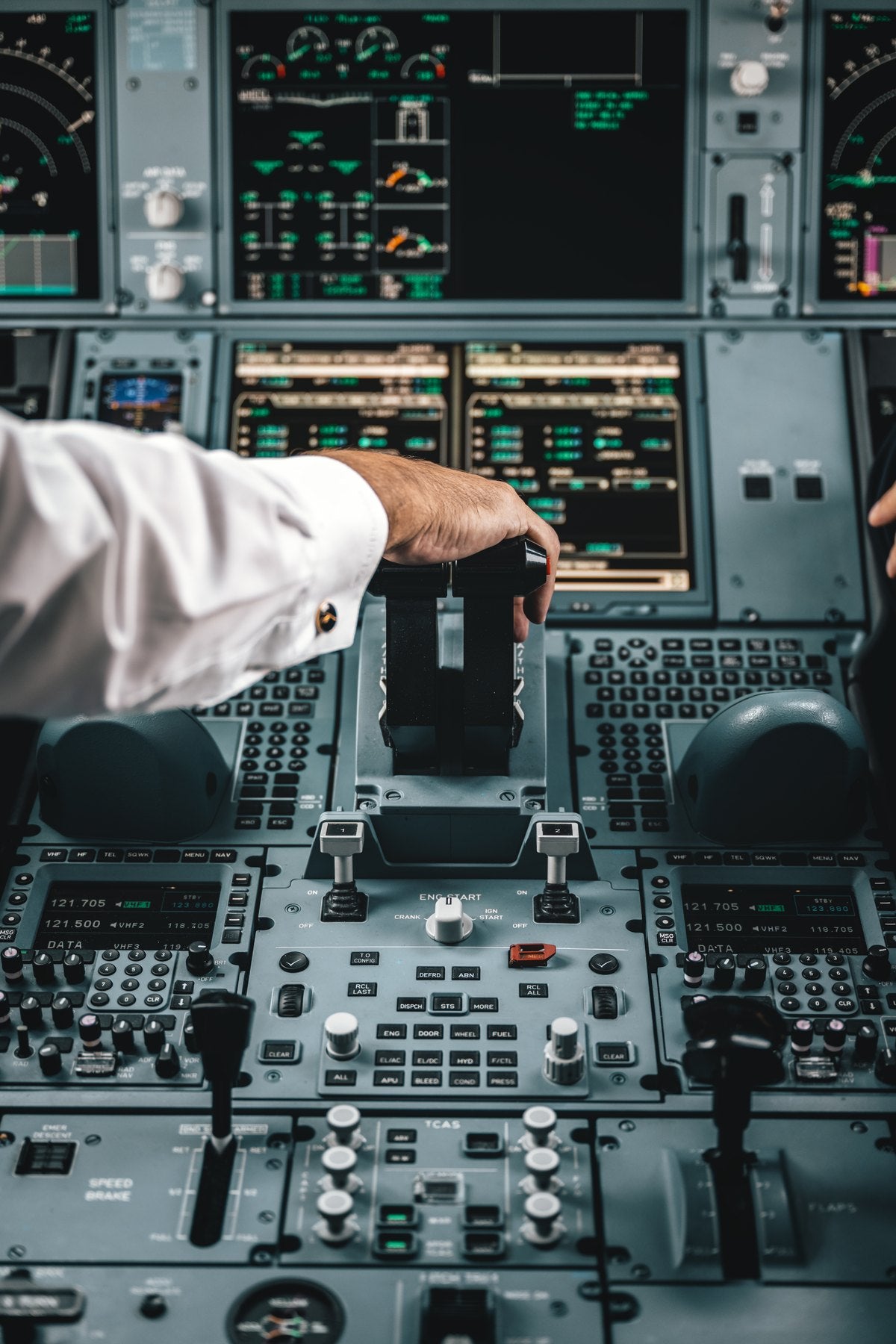
A few minutes on the flight deck
After several laps over the mountains, I was allowed to drop in on the flight deck for a few minutes. We are over western Trentino, climbing through about 16,200 feet to 17,000 at 250 knots. The heading is 322, north-west, towards home. The next waypoint, ATPED, sits just west of the Adamello summit. After that come RESIA on the Swiss border near Livigno and PELAD near Bergün in Graubünden.

Down on the centre pedestal, the FMS shows OPT ALT FL410. For our weight, the computer rates 41,000 feet as the most efficient altitude. The A220 isn’t certified for anything higher. Right next to that line, our cruise altitude reads FL170. On a flight flown for the view, the optimum doesn’t get a say.
The displays also give the wind away. We are doing 318 knots through the air but only 247 over the ground, so a headwind of about 70 knots is coming at us from the north-west. The 12 UTC weather balloon from Payerne in western Switzerland measured about 74 knots from the north-west at this height.

Is the A220 a Bombardier or an Airbus?
Both, in fact, and the paperwork still shows it. Bombardier launched the aircraft as the CSeries in July 2008. The CS100 first flew on 16 September 2013 from Mirabel near Montreal and stayed up for two and a half hours, climbing to 12,500 feet. Swiss flew the first paying passengers on 15 July 2016, from Zurich to Paris.
In April 2017 Boeing filed a complaint in Washington, and that autumn the US Commerce Department proposed duties of almost 300 percent on CSeries jets imported into the United States. In January 2018 the US International Trade Commission voted 4 to 0 that the jets neither harmed nor threatened the American industry, and the duties never came. Airbus had stepped in by then. In October 2017 it agreed to take 50.01 percent of the programme without paying any cash. The deal closed on 1 July 2018, and on 10 July the CS100 became the A220-100.
The type certificate still lists the A220-100 as the BD-500-1A10, and on a flight plan the aircraft is filed as BCS1. Transport Canada explains the change in one dry sentence: “The marketing names have been changed from CSeries to the A220 because of change in ownership …”
What makes the A220 different?
The PW1500G engines were the first of Pratt & Whitney’s geared turbofans to be certified, in February 2013. A gearbox lets the 73-inch fan turn about three times slower than the shaft that drives it, because a big fan works best slowly and a turbine works best fast. Airbus credits the whole package of engines, materials and aerodynamics with 25 percent less fuel per seat than the previous generation and a noise footprint up to 50 percent smaller.
The A220-100 is also certified for steep approaches of up to 5.5 degrees into London City, almost twice the usual three. The first scheduled flight into London City came from Zurich on 8 August 2017, when the type was still the CS100. The longer A220-300 is not approved for it.
Bombardier gave the aircraft fly-by-wire and two sidesticks years before Airbus came on board. An A320 pilot still needs a separate type rating for it, called BD-500. When the autothrottle changes the thrust, the thrust levers move with it, which no other Airbus airliner in production does. There is no “retard” callout in the flare either, the reminder A320 pilots hear at 20 feet to bring the levers back.
In economy there are five seats across, two on one side and three on the other. The middle seat is the widest, at 19 inches. For once, it might be the one to ask for. You can tell Bombardier started the A220 on a clean sheet of paper. For me, it’s the most comfortable aircraft on short-haul routes right now.

How many A220s are there?
At the end of September 2026 Airbus had 1,107 orders for the A220 and had delivered 550. They come off three final assembly lines, two in Mirabel and one in Mobile, Alabama, and Airbus counted 25 operators in March 2026. The A220-100 is still the smallest aircraft in Airbus’s airliner range.
Alpine Pass is in the shop as a fine-art print on baryta paper or behind acrylic glass. More photographs from the window seat are in the wing view collection.
Thank you to Zurich Airport and to the crew of LX 7525 for a great day out. I hope you enjoyed reading along.
Happy landings,
Aaron