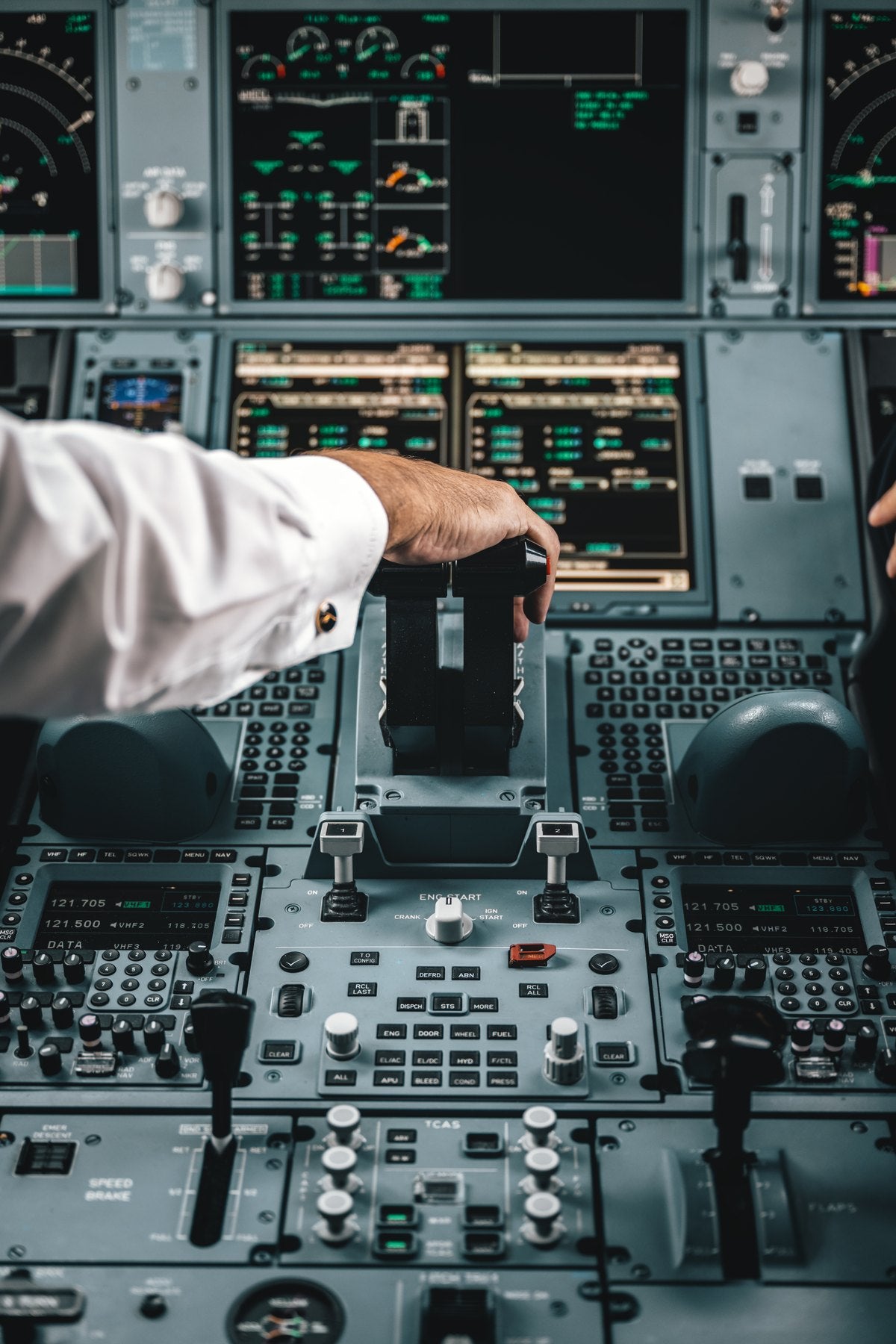
Late at night in Frankfurt a Boeing 777 Freighter is waiting with 108 tonnes of fuel in its tanks, and I have the best seat in the house: the jump seat, one of two extra seats in the cockpit, right behind the two pilots, with one of the finest views in aviation. Ahead of us are twelve and a half hours to Tokyo Narita, one sunrise, and a golden hour that turned into the print Golden Approach to Tokyo.
Runway 18, 22:48
The clock on the panel shows 20:48 UTC, 22:48 in Frankfurt, as we taxi out to runway 18. Frankfurt’s Startbahn West is 4,000 metres long, runs north to south along the western edge of the airport and is used for take-offs only. I have spent many hours at my favourite spotting place watching aircraft line up on exactly this runway, so rolling onto it from the inside is a small full circle.
The displays say everything is set: flaps 15, V2 170 knots, the speed at which the 777 can still climb away safely with one engine out, and 108.7 tonnes of fuel. One detail for the nerds among you (hello, I am one of you): next to the engine readings it says D‑TO +40 °C. The crew has told the engines it is 40 degrees outside while the thermometer says 15. With 4,000 metres of concrete ahead, the aircraft does not need every last pound of thrust, and this small white lie lets the engines run cooler and live longer.
There are four pilots on board tonight: a captain, a senior first officer and two first officers. Twelve and a half hours is longer than anyone should spend in one chair, so they take turns, and while two fly, the other two sleep. The flight is this long because Russian airspace has been closed to European airlines since 2022. The old way to Tokyo went straight across Siberia. Today’s route runs south through Turkey and Central Asia and costs about two hours more.

Cleared for take-off
Lined up on runway 18, the lights run into the dark until they meet. Then the clearance comes, the captain pushes the thrust levers forward, and the two GE90s change from a hum to a roar. The calls come as rehearsed: 80 knots, V1, rotate. At 170 knots the nose points into the night sky and the lights of Frankfurt fall behind us.

Sunrise at 33,000 feet
Then hours of darkness. A freighter at night is a calm place. Behind the cockpit door there is a galley and a few seats with very decent legroom, then only cargo. Up front: two pilots awake, amber light and me, trying not to fall asleep and losing that fight somewhere after the first fuel check.
Four hours in, somewhere over Kazakhstan, the sky ahead turns from black to deep blue to orange, and the sun climbs over the horizon straight into our faces. We are at 33,000 feet, Mach 0.82, heading 077, with 70.1 tonnes of fuel left and more than eight hours to go. The whole cockpit fills with gold, every scratch on the windshield becomes a star, and the sun visors are suddenly the most important equipment on board.

Down towards Narita
China comes and goes below us, then South Korea, then the sea. At 09:19 UTC, 18:19 in Tokyo, we are descending through 8,100 feet to 6,000 at 210 knots. The ILS for runway 16L is tuned, autobrake 4 is set, the flaps are at 1, and the next waypoint, CASIO, is 14.7 nautical miles ahead. The elapsed-time clock shows 12:16, and the tanks hold 12.4 tonnes, so roughly 96 tonnes of kerosene have gone through the two engines since Frankfurt. The seatbelt sign is on, mainly for me.

The golden approach
One minute later, this. Air traffic control takes us off the planned arrival and vectors us towards the final approach. In the picture we are flying a heading of 289 degrees, almost staring straight into the setting sun. For a few minutes the sun sits on the top edge of the windshield and fills the cockpit with light, in rays across the overhead panel and onto the sleeve of the pilot in the right seat. The camera was up anyway. This frame became the print Golden Approach to Tokyo, and if you look closely you can gather a lot of information from the displays: 12:17 on the elapsed-time clock, 12.2 tonnes of fuel, autobrake 4, CASIO 11.7 miles ahead.

By hand onto 16L
Then the pilot flying switches off the autopilot and the autothrottle and flies the rest by hand. Ahead, the land around Narita is greener than you would expect an hour from Tokyo, and runway 16L grows in the windshield. The flare, a chirp from the main gear, reverse thrust, and 12 hours and 29 minutes after Frankfurt the 777 is on the ground in Japan. It is half past six in the evening.


Feierabend
In German we have a word for this moment: Feierabend. It means the end of the working day and the free evening that begins right there, and you can wish it to someone. Schönen Feierabend! English has closing time and quitting time, but neither sounds like a cold drink on a warm evening. For the crew it is Feierabend in theory only, because there are still 15 minutes of taxiing to the cargo ramp, past Terminal 2 and its row of Japan Airlines tails.

A sea turtle and a GE90
On the way we pass one of the most photographed aircraft in Japan: an ANA Airbus A380 in Flying Honu colours. ANA has three of them, painted as Hawaiian green sea turtles in blue, emerald green and orange, and they fly one route only, Narita to Honolulu. Ours is the green one, Kai, named after the Hawaiian ocean. An A380 that commutes to Hawaii for a living. Some aircraft have it all figured out.
At the ramp, one last look at engine number one before the Feierabend becomes real. The GE90 is still the biggest thing about a 777. On the freighter each one delivers about 110,000 pounds of thrust, the fan is 3.25 metres across, and its bigger brother, the GE90-115B, held the world record for thrust from 2002 until the next generation of engines took it. The 22 fan blades are carbon fibre and so elegantly curved that one of them is in the collection of the Museum of Modern Art in New York. I will show you one from the inside in a minute.


Shinjuku
Then the city. A train takes you from Narita to Shinjuku in a good hour and drops you at the busiest railway station in the world: about 3.5 million people pass through it every day, nearly the population of Berlin. After twelve hours of amber cockpit lighting, the neon of Shinjuku is a lot, in a good way. Dinner was never in doubt: a bowl of iekei ramen at Ichikakuya, the Yokohama style with a pork-bone and soy sauce broth and thick noodles. The best meal after a long flight is the one that does not come in a foil tray.


Thank you, and happy landings

That is me inside engine number one, next to the spinner, for scale. This was my first time in Tokyo, delivered by a 777 Freighter and four pilots who let me sit behind them for twelve and a half hours and answered every one of my questions, and there were many. Thank you.
If you want that golden hour on your own wall, the frame from the approach is in the shop as Golden Approach to Tokyo, as a fine-art print on baryta paper or behind acrylic glass, and there are more photographs from the flight deck next to it.
Happy landings,
Aaron