A calendar sorts its pictures by month. Lay the pages of Flight Deck 2027 out by phase of flight instead, and they become a single flight, from a quiet cockpit on the ground to the final taxi in to the gate. All twelve photos are mine. I am Aaron Püttmann, a photographer from Frankfurt, and aircraft are my favourite subject.
The catch is that the aircraft type changes ten times along the way. Nobody has ever flown it like that, and even the best travel agent could not book it for you. The photos span flight decks from the Boeing 737-400 with its round dials to the Airbus A350 with its keyboard and trackball. Below, they follow the order of a flight, each page with one or two details that are easy to miss in the photo. If one month interests you most, the list takes you straight there.
 The calendarFlight Deck 2027Twelve cockpit photos, roughly A3
- January · Airbus A320neo · Frankfurt, seconds after lift-off
- February · Airbus A350-900 · Palma de Mallorca, after engine start
- March · Boeing 787-9 · Frankfurt, taxiing to the gate
- April · Airbus A319 · approach to Frankfurt
- May · Airbus A321neo · cruise at sunrise
- June · Boeing 747-8 · Palma de Mallorca, before take-off
- July · Boeing 777F · descent towards Tokyo Narita
- August · Boeing 737-400 · on the ground
- September · Airbus A321 · final approach to Baku
- October · Airbus A350-900 · descent towards Munich
- November · Boeing 777F · Seoul Incheon, shortly before taxiing
- December · Airbus A321 · final approach to Bilbao
On the ground: four airliner cockpits before take-off

Long before a single wheel turns, the work begins overhead. The overhead panel of the 737 holds the switches for electrical power, fuel pumps, pressurisation and engine start.
The 737-400 is the oldest type in my calendar. You can tell from the round gauges, the toggle switches and the magnetic compass on the centre post of the windshield. Its first flight was almost three decades before that of the youngest type. On paper, its story goes back even further. The type certificate dates from 1967 and the very first 737, the 737-100. The 737-400 was added to it in 1988. To this day, EASA lists the Classic, the Next Generation and the MAX on one type certificate data sheet. Officially, these round gauges and the screens of a 737 MAX still belong to the same family.
The US authority, the FAA, has a single type rating for the whole family. From the 737-100 to the MAX, it is simply called “B-737”. According to the trade press, the airlines wanted to keep it that way, so that their pilots can move between old and new 737s without a new rating. A modern alerting system would have required a new one. That is why a 737 MAX still has almost the same overhead panel as the 737-400 in this photo.
Why the 737 lost its eyebrow windows
The eyebrow windows, the four small windows above the windshield, used to give the crew a better view upwards, especially in turns. When the first 737 without them rolled out in 2005, Boeing explained that modern navigation systems had made them obsolete. By its figures, the change makes each aircraft about 9 kilograms lighter and saves around 300 hours of periodic inspections. For the 737s already in service, it announced retrofit kits to cover them. Look to the left and right of the overhead panel in this cockpit: the lined recesses with the small lamp are the covered eyebrow windows.

The flight for this photo was my very first on a 747, and I got to spend it in the cockpit. I could hardly have asked for more, especially since the 747 is my favourite aircraft.
There are four thrust levers for four engines, and helpfully, each one carries the number of its engine. Seen from the cockpit, the engines are counted from left to right: number 1 is the outer engine on the left, number 4 the outer one on the right.
Anyone sitting here has their eyes 8.71 metres above the tarmac, roughly a storey higher than in a 777. The whole 747-8 is 76.3 metres long. No airliner in scheduled service is longer, at least until the 777-9 arrives with its 76.7 metres. That is a lot of aeroplane to get round a corner. The 747-8 rolls on 18 wheels. Besides the nose gear, its two body gears steer as well. With that body gear steering, a 180-degree turn needs a strip 52.4 metres wide; without it, 69.5. Boeing’s airport planning document for the 747-8 notes that the turning radii are based on an earlier test with a 747-200.

With pushback and engine start done, the 777 will begin to taxi any moment now. Its two main gears have six wheels each. Once the nose wheel turns far enough, the aft axle of each main gear steers as well. Boeing says this allows for less tyre scrub and easier manoeuvring into gates with limited parking clearance.
Outside, a row of 747 freighters stands under the floodlights. Boeing deliberately designed the 777 Freighter to fit in with them: through the large main deck cargo door, pallets three metres high can be moved from one type to the other. A row like this is nothing unusual at Incheon. The airport is open around the clock and most recently ranked seventh in the world for air cargo, with 2.95 million tonnes in a year.
The cockpit stays dark. The rods in your eyes need about 30 minutes to get fully used to the dark. A single bright light undoes all of it. A camera flash would have been the worst idea of the night.

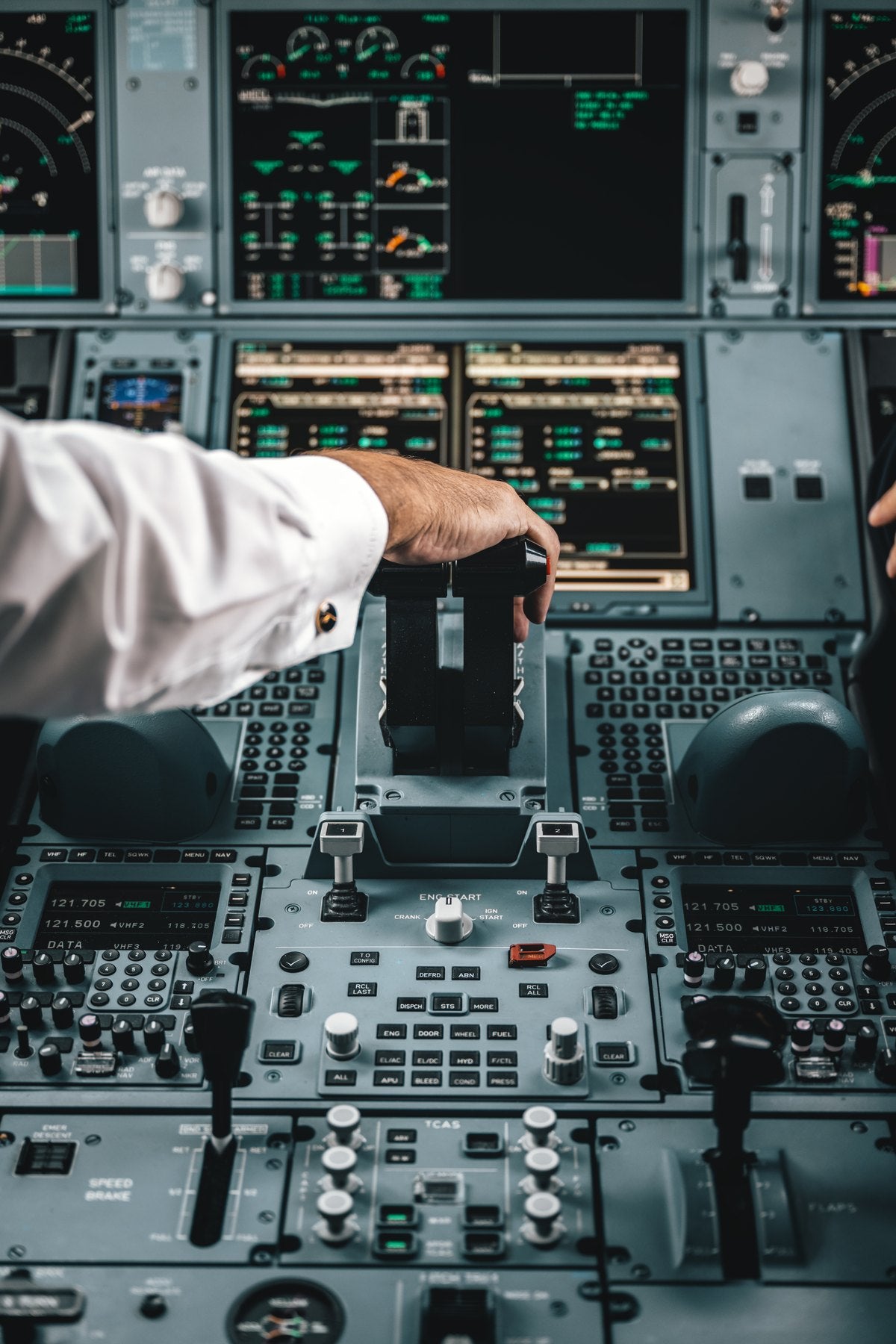
The two thrust levers control two Trent XWB engines, both at idle for now. At take-off, each one draws in up to 1.3 tonnes of air per second, according to Rolls-Royce.
The radio shows 121.705 as active, which in Palma is ground control for the south side. The standby frequency is still 123.880, clearance delivery. That tells you who the crew is talking to now and who they spoke to before. Strictly speaking, 121.705 is the name of a channel. The radio transmits on 121.700 MHz, in the narrow 8.33 kHz spacing, which fits three channels where there used to be one. The only real frequency in the picture is one line further down: 121.500, the emergency frequency, which still uses the old, wider spacing.
Take-off: 35 feet above Frankfurt

The 35 feet on the radio altimeter are a nice coincidence. Under the certification rules for large aeroplanes, the take-off distance on a dry runway ends where the aircraft is 35 feet above it. The same rules assume that the gear does not start to retract until the wheels have left the ground. That assumption is there for the certification arithmetic and says nothing about when a crew raises the gear. In the photo, the hand is on the lever already, while the three green triangles of the gear indicator are still lit.
The top line of the primary flight display reads “MAN FLX +54”, which means a take-off with less than full thrust. For this, the crew enters an assumed temperature, 54 degrees here, and the engines deliver only the thrust they would still have in that heat. Outside it is 10 degrees, according to the reading further down in the picture. This works when the aircraft is lighter than the maximum allowed that day. The engines last longer that way, while full thrust remains available at any moment.
On the engine and warning display, “T.O INHIBIT” is shown in magenta. In the busiest phases of a flight, the flight warning computer holds back every alert that is not urgent, on take-off until 1,500 feet or two minutes after lift-off. Remember this line. It comes back in December.
Cruise at sunrise

Autopilot and autothrust are on. See the dashes with the dot in the speed and heading windows? They show that the flight management computer is setting those values right now. Once the knob underneath is pulled, the value dialled in by hand takes over again. Only the altitude window always shows a number, 34000 here.
The METRIC ALT button to the right of it shows the same altitude in metres as well. That is for places where air traffic control gives altitudes in metres, such as China and Mongolia. Even there, aircraft are flown in feet, with the matching altitude taken from a conversion table.
The clock at the bottom right shows 02:53 UTC, whatever country we happen to be over. This time is set by ICAO, the UN organisation for civil aviation. The European rules simply adopt it. Up here we see the sunrise before the people directly below us. From 34,000 feet the view reaches about 360 kilometres. The horizon sits a good 3 degrees below eye level, which lets the sun appear a little sooner, by roughly a quarter of an hour.
 From the calendarFlight Deck 2027The May page and eleven more
Descent and approach

The camera looks straight down onto the centre pedestal, the console that separates the left seat from the right one. Next to the thrust levers, each side has a keyboard with a trackball, which Airbus calls the pilot’s “mouse”.
The transponder display reads “SQWK 1000”. A squawk is a four-digit code that air traffic control assigns to a flight and the crew sets on the transponder. Whenever the radar interrogates it, the transponder replies with that code, which tells the controller which dot on the screen is which flight. Code 1000, however, is the code for not needing a code of your own. Modern transponders also send the flight identification. Air traffic control in Europe recognises the aircraft from that and saves one of only 4,096 codes. There are no more than that, because each digit only goes from 0 to 7.
On the right of the picture, the flap lever is at 0. Even so, the A350 moves its flaps in cruise too, on its own and only by a few degrees, 4 at most. This way it keeps adjusting the camber of the wing and spreads the load more favourably. Airbus calls the two functions Variable Camber and Differential Flaps Settings. In its words, both are “fully transparent for the pilots”. The lever stays at 0. There is no switch for any of this.

A strip of thermal paper sits among all the screens of this cockpit, like a till receipt. This is the ATIS, the airport’s current weather and airfield information. It reaches the cockpit by datalink. EASA explicitly allows a printer to be the primary display for these messages. That little slip is, officially, a primary display.
What does CAVOK mean?
The printout says “CAVOK”, short for “Cloud and Visibility OK”. In a weather report, this one word replaces three groups at once, but only when all of them are true at the same time. Visibility is 10 kilometres or more. There is no cloud below 5,000 feet, a limit that is higher at some airports, and no thunderclouds or towering cumulus anywhere. Nor is there any significant weather. A solid layer of cloud at 6,000 feet still counts as CAVOK. A photographer’s idea of OK would be rather stricter.
“07003KT” on the slip means wind from 070 degrees at 3 knots. Runway 07R points roughly the same way, because a runway number is its magnetic direction, rounded to the nearest ten and without the last digit. For the landing, that puts the wind almost straight on the nose.

After more than twelve hours in the air, this 777F is nearly at its destination, with the sun almost dead ahead and still about 5 degrees above the horizon.
I will remember this light for a long time. It was my first trip to Japan, and with Tokyo ahead I was already thinking about the food, the sights and a city that is as busy at night as it is by day.
We are on approach to Narita, which for a freighter is the main gateway to Japan: just over half of the country’s international air cargo passes through this airport. Down below, the coast is already in the haze.
At 7,330 feet, descending to 6,000, we are right in the middle of the phase known as the sterile cockpit, when everything that does not serve the flight is put on hold. In the US and the EU alike, it begins below 10,000 feet. The US rule even names announcements “pointing out sights of interest” among the duties that are not needed to operate the aircraft safely. In a freighter that temptation is easy to resist: the main deck carries pallets, and pallets have never once asked about the view.
Final approach: the view from the jump seat

I took this one from the jump seat. The rule books use a plainer name, the observer’s seat. In the A321 it sits behind the centre pedestal. The word jump seat is older than the aeroplane: it comes from the days of horse-drawn carriages, when it meant a movable extra seat.
You can read these lights. The red rows to the left and right of the white centreline mark the last 270 metres before the threshold. The green crossbar marks the threshold itself, where the landing distance begins. Beyond it, the white fields of light are the touchdown zone, the first 900 metres.
Photographers call this light the blue hour. Officially it is already night, at least by the definition used in Europe: night begins when the centre of the sun is 6 degrees below the horizon. In Baku, depending on the season, that happens 27 to 33 minutes after sunset. When I took this photo, the sun had been down for just under 40 minutes.
The last 140 feet

Three green triangles on the left of the picture report the gear down and locked. The same three are lit on the January page, though there only until the gear comes up.
The engine and warning display now shows “LDG INHIBIT”, the counterpart of the line from the take-off. From 800 feet until 80 knots after touchdown, the flight warning computer once again holds back whatever can wait.
On the way down, the aircraft follows the glide path, a radio beam from the instrument landing system, the ILS. The PAPI lights next to the runway show the same angle to the eye. ICAO recommends 3 degrees and allows more only where obstacles cannot otherwise be cleared safely. For Bilbao, Spain’s aeronautical information publication lists 3.4 degrees for the glide path and the PAPI of runway 30.
The publication gives no reason, but the airport’s location suggests one. It lies in the Asúa valley, which is open towards the sea and closed off at the other end by hills a little over 300 metres high. To the south-east, Mount Ganguren rises to 477 metres. That is the direction the approach to runway 30 comes from.
The display shows a ground speed of 153 knots, which on this path means a descent of about 920 feet per minute. At the usual 3 degrees it would be 810. ICAO still counts this as standard and only draws the line at 3.5. EU rules speak of a steep approach from 4.5 degrees. London City, for comparison, uses 5.5 degrees, which the airport puts down to the tall buildings around it.
Next comes the flare, when the nose rises a little further. That is where the A321 has less margin than its shorter siblings. At 44.51 metres, it is 6.94 metres longer than the A320. Its tail would touch the runway at 9.7 degrees, the A320’s only at 11.7.
The stay that followed was well worth it, by the way. I went to the Guggenheim Museum, which was great, and the rest of Bilbao has plenty going for it too.
On the ground: taxi to the gate

After a long night flight, our 787 is taxiing to the gate. Ahead of us, an Airbus A340-600 is under tow. These two have met before. The 787 brakes electrically instead of hydraulically. While it was being developed, one of its brake makers flight-tested a slightly different electric system. The test aircraft was an A340-600!
The A340-600 measures 75.36 metres, which makes it the longest Airbus ever built and 12.55 metres longer than the 787-9. Among passenger jets it held the length record until the 747-8 beat it by just under a metre. Both are in the calendar: the 747-8 in June, this one as a guest outside the windshield.
The last scheduled A340-600 flight into Frankfurt landed on 19 October 2026. Which makes the March page a fond memory of the A340-600 for me.
How the photos became a calendar
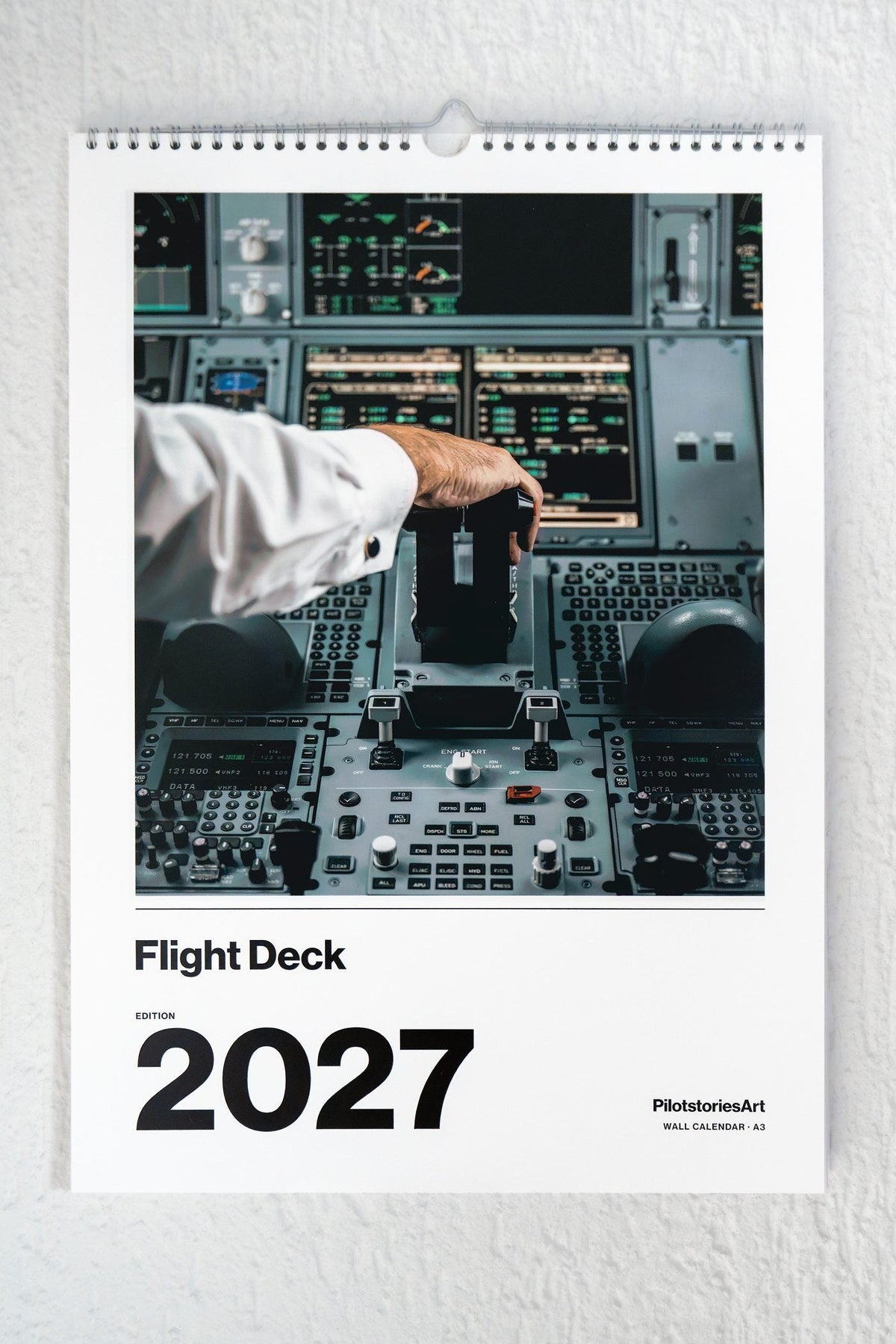
Flight Deck 2027 is a wall calendar of 30.5 × 43 cm, roughly A3, printed on heavy matte paper with a spiral binding. Twelve photos from nine aircraft types: seven pages Airbus, five pages Boeing.

I wanted to show my photos somewhere other than social media, and I wanted a calendar like this myself. So I just made one. Simple as that. These are twelve of my favourite photos from the jump seat, and each one comes with a good memory. A few of those memories get the full treatment in my flight deck stories. Some of the photos are also available on their own as cockpit prints for the wall.
The February photo made the cover because I think it is the most beautiful of the twelve, and because the hand on the thrust levers captures the action in the cockpit so well.
Sorted by month, the flight works too, by the way: January takes off and December lands. The months in between are less tidy. In February the engines have only just started, and by March we are already taxiing to the gate. You will find the whole flight, in whichever order you like, in the Flight Deck 2027 aviation calendar.